July 21, 2026
Stewardship Over Ownership: How Drake Sadler Built a Company to Outlast Its Founder
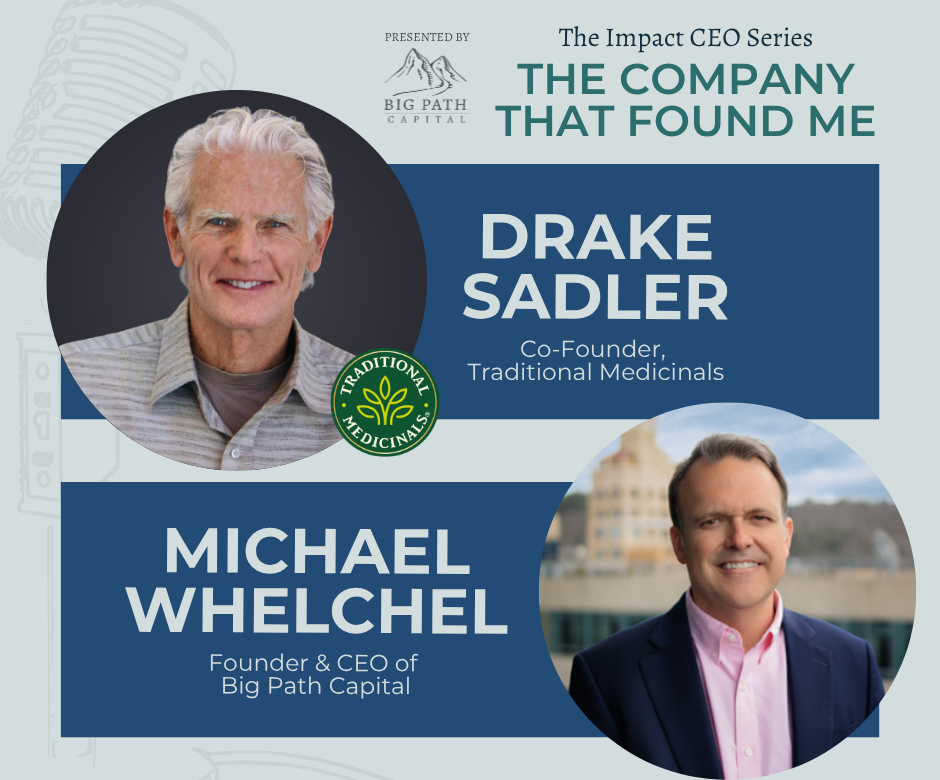
For more than 50 years, Drake Sadler has led Traditional Medicinals with a belief that runs counter to the traditional founder narrative: the company was never truly his to own. In this Impact CEO Series conversation, Big Path Capital Founder and CEO Michael Whelchel sat down with Sadler to explore how that philosophy has shaped every major decision, from leadership and ownership to succession and long-term purpose.
When Business Became a Vehicle for Service
Growing up with entrepreneurial parents, Sadler was surrounded by business from an early age. But as a young adult during the social and political unrest of the 1960s, he became deeply skeptical of the role corporations played in society. Rather than following in his father’s footsteps, he initially rejected business altogether.
That perspective shifted when Traditional Medicinals emerged in his twenties. What began as an entrepreneurial venture quickly evolved into something much larger. Sadler came to see business not as an engine for wealth creation, but as a platform for meaningful social change. A pivotal visit to farming communities in Guatemala reinforced that belief.
Witnessing the realities faced by the people who supplied the company’s herbs, he realized that Traditional Medicinals had both the opportunity and the responsibility to invest in those communities. Not through charity alone, but by building long-term partnerships that created education, healthcare, and economic resilience.
“I realized the purpose was to return to those places and do everything the business could to uplift those communities,” Sadler reflected.
Rethinking What It Means to Own a Company
As Traditional Medicinals grew, Sadler became less interested in ownership itself and more focused on protecting the company’s purpose. His succession journey has been anything but conventional.
Over the years, he experimented with gifting equity to members of his leadership team, implementing an Employee Stock Ownership Plan (ESOP), and transferring ownership to a nonprofit foundation. Each approach brought valuable lessons, but each also revealed limitations as laws changed and governance structures evolved.
Today, Traditional Medicinals is transitioning to a perpetual purpose trust, an emerging ownership model designed to ensure the company remains governed by its mission rather than by future shareholders’ financial interests.
For Sadler, the goal has never been to preserve his control. It’s been to preserve the company’s values.
Success Is Both a Blessing and a Burden
One of the most thought-provoking moments in the conversation centered on Sadler’s definition of success.
While growth creates more opportunities to expand impact, he warned that success can also become a trap for founders. Too often, entrepreneurs begin to identify themselves with what they’ve built, believing the company exists because of them.
“I think all the resources that have been put in front of us are a loan,” he said. “We have them for some period of time. They’re there to be used properly.”
Viewed through that lens, he says stewardship becomes something very different from ownership. Leaders aren’t accumulating assets; they’re temporarily responsible for using those assets in the service of something greater than themselves.
That philosophy has guided Traditional Medicinals for decades, allowing the company to invest in communities across more than 40 countries while continuing to grow its business.
Building an Organization Bigger Than Its Founder
As Traditional Medicinals enters its sixth decade, Sadler is intentionally stepping further away from day-to-day leadership. While the company has begun documenting its history, he hopes future generations remember the organization’s mission more than the people who started it.
Drawing comparisons to organizations like Greenpeace and the Red Cross, Sadler argued that truly enduring institutions eventually become known for what they stand for. Not who founded them.
Rather than asking how his legacy will endure, Sadler asks a different question: how can Traditional Medicinals continue to fulfill its purpose long after its founders are gone?
The Lasting Impact
Drake Sadler’s story challenges many of the assumptions surrounding entrepreneurship, ownership, and success. Rather than building a company to maximize personal wealth or create a lasting legacy, he has spent decades designing a business that can thrive without him. His journey demonstrates that stewardship isn’t simply a leadership philosophy. It’s an ownership philosophy, one that prioritizes mission over control and purpose over permanence.
Watch the full conversation here: